``

Showing posts with label education. Show all posts

Monday, January 5, 2015

What Does Monday, Birds and Whipped Cream Have In Common?


They all share a National Day of January 5th together. Bet you didn't know that, ask your homeschoolers if they knew that one too. National days can provide an opportunity to learn , educate and discuss all while having lots of fun.
My favorite site for information related to "national day lists" is www.NationaldayCalendar.com , subscribe to the newsletter and get their daily listing for each day in your inbox.

NATIONAL THANK GOD IT’S MONDAY DAY

National Thank God It’s Monday Day is celebrated each year on the first Monday in January. This day was created to celebrate all things that start/happen on a Monday in the the upcoming year, such as; a new job, a promotion, birthdays, holidays, vacations and etc. This is also a day, which starts out the first full week of the new year, to look ahead with positive hope, energy, enthusiasm and excitement for all things to come in the next 12 months.

National Bird Day

Born Free USA emphasizes the importance of National Bird Day and lists it as a day to shine a spotlight on issues critical to the protection and survival of birds, both captive and wild.
National Bird Day, an “unofficial” national holiday, was created to promote avian awareness.
According to Born Free USA, nearly 12 percent of the world’s almost 10,000 bird species are in danger of extinction.

Celebrated annually by half a million adherents through:

  • bird-watching
  • studying birds
  • educating others
  • other bird-related activities
  • A particularly important National Bird Day activity is bird adoption. According to the Atlanta Journal Constitution newspaper article, many bird enthusiast celebrate by adopting birds on this day and educating future bird owners about the special issues involved with taking care of birds, including the “proper care, cleanup, noise and biting, feeding, diet and their need for daily interaction”.
Watch for another full post related to studying birds soon.


NATIONAL WHIPPED CREAM DAY

There is that little something that adds a final touch to ice cream sundaes, cake, milk shakes, hot cocoa, pie, pudding and many other desserts and it is annually celebrated on January 5. This is National Whipped Cream Day.
This holiday falls on the birthday of Reddi-wip founder Aaron “Bunny” Lapin. Aaron who invented Reddi-wip in 1948, was born on January 5, 1914 and died on July 10, 1999.
National Whipped Cream Day celebrates whipped cream’s contribution to the dessert world.
Often sweetened and sometimes flavored with vanilla, coffee, chocolate, orange and other flavors, whipped cream is also sometimes called Chantilly cream orcreme Chantilly.
Recipes from the 16th century included whipped cream that was sweetened and aromatised. The names “milk snow” and “snow cream” were used. In these recipes, naturally separated cream is whipped, typically with willow or rush branches, then the resulting foam on the surface would from time to time be skimmed off and drained, which was a process taking an hour or more.
The English name “whipped cream” found it’s beginning in 1673. The name “snow cream” continued to be used throughout the 17th century.
To celebrate National Whipped Cream Day, try one of the following “tried and true” recipes:


b03e4509af7396c7457f65faac7b78c32b3a8ebf6a4ec24a6d

Saturday, September 13, 2014

Building a Better Student with Dom Testa-- Spell Check #education #learningtools


One of my co-workers at the radio station said something interesting to me this week. He said, “Spell check made me into a good speller.”
At first I thought he was kidding, but no. He told me that he was horrible at spelling when he was younger, but through the years spell check taught him. And it stuck. Today his computer and phone rarely need to correct him.
I walked away and thought about the significance of this observation. At their core people seem to scowl at technology in terms of education and all-around learning. 
In fact, almost daily we hear someone lament that “kids ain’t learnin’ nothin’ with them darned screens in their face all day.”


But is that true?

Try doing an online search using these five words: How technology helps students learn.
You’ll discover a vast archive of stories, studies, and stats that show how devices - even the frightening phone or the terrifying tablet - can open up a world of information to students who perhaps never found education . . . well, interesting.

Our non-profit foundation, The Big Brain Club, provides all sorts of services and resources to schools, but we always try to make technological donations an important part of the equation. Why? Because teachers tell us that gadgets often help them to connect with students who otherwise would sit in the back of the room with their arms crossed.
It will be argued, of course, that some kids will try to sneak over to the games instead of the lesson, but that’s not a generational thing; it’s human nature. And it shouldn't detract from the positive effects that lurk at our fingertips. 
What, we throw out the entire system because a few people corrupt it?

Voltaire taught us that perfect is the enemy of good. Well, electronic tools can be harnessed for good. Lots of good.


Instead of crusading to get phones and tablets out of the hands of students, let’s search for more ways to make each gadget an accessory to education. If, over time, spell check can help a grown man - who we normally view as stuck in his old habits - to become more proficient with language skills, then imagine what other devices can do if unleashed upon minds that are more naturally open to learning.

I spell that S-u-c-c-e-s-s.

Dom Testa is an author, speaker, morning radio show host, and has kept a ficus tree alive for twenty-four years. He’s also the founder and president of The Big Brain Club, a non-profit student-development foundation. His new book, Smart Is Cool, is now available. More info at www.DomTesta.com.

Friday, September 5, 2014

Building A Better Student: Circles From The Air #series

Circles From The Air

By Dom Testa


The flight from Austin to Denver was routine. We pulled away from the gate right on time, the guy next to me had already drifted off to sleep with his ear buds snugly tucked, and I settled in with a million-page Michener novel. (Is that redundant?)

After so many years of choosing window seats, the view from 37,000 feet was familiar and strangely comforting. The lakes, the highways, the shadows caused by stray clouds, 
the thousands of circles . . .

Those circles. Have you noticed them? The endless patchwork, dotting the landscape? Have you ever turned to the person next to you and said, “What’s up with the circles?” (Note: If the person is asleep with ear buds jammed into his head, don’t do this.)


Funny, but I've never remembered to investigate this question after touching down and retrieving my carry-on bag from the overhead compartment - whose contents may have shifted during the flight. And then on the next flight I’ll find myself peering through the acrylic pane again and wondering.

This time, however, I made a note on my phone: Circles from the air.

Turns out that it’s not the most exciting answer - sorry, no aliens - but at least I’ll know it for the rest of my life, which will be helpful in case I’m ever the guy in the middle seat. It also made me realize something else.

(First, the simple answer. The plethora of circles are the result of something known as center-pivot irrigation, or sometimes simply called circle irrigation. It’s a form of crop watering that allegedly works better and conserves natural resources. Long tubes roll on wheels around a center pump, creating round crops and . . . well, that’s enough about that.)

Here’s what popped into my head after reading up on this farming technique: If I was a four-year-old, I’d pester the hell out of my parents until they explained what those circles were. Four-year-olds ask WHY - along with other questions - something like 250 times a day.

A day!

In fact, we’re at our most curious at age four. After that, apparently, we pick up on the fact that mom and dad are mentally exhausted and we clam up.

But curiosity is vitally important. It’s true that we live in an age where information is so readily available (not all of it accurate, of course) that we’re almost numb to it.

We swim in a sea of minutiae, and I wonder if that diminishes our natural interest in learning. Sadly, I know how many yards rushing my favorite team had in a silly pre-season game, but I’d never bothered to find out about something that actually feeds me on a daily basis. I’d stopped asking WHY?

Perhaps you can extend the lifespan of your child’s curiosity. I know we get cranky after Question #214 - that’s usually around 5:45PM - but we should suck it up and remember what a great gift it is. We WANT curious children; shutting them down means a population of mental zombies who aren’t engaged beyond 140 characters or mindless YouTube stunts.

My pursuit of circle knowledge took two minutes. The greater awareness, though, will help me for years. Are you on board?


Dom Testa is an author, speaker, morning radio show host, and has kept a ficus tree alive for twenty-four years. He’s also the founder and president of The Big Brain Club, a non-profit student-development foundation. His new book, Smart Is Cool, is now available. More info at www.DomTesta.com.

Join my friend Dom here weekly for his series Building a Better Student, I am excited to start sharing his fabulous writing here on my blog. Leslie ~~


Monday, December 2, 2013

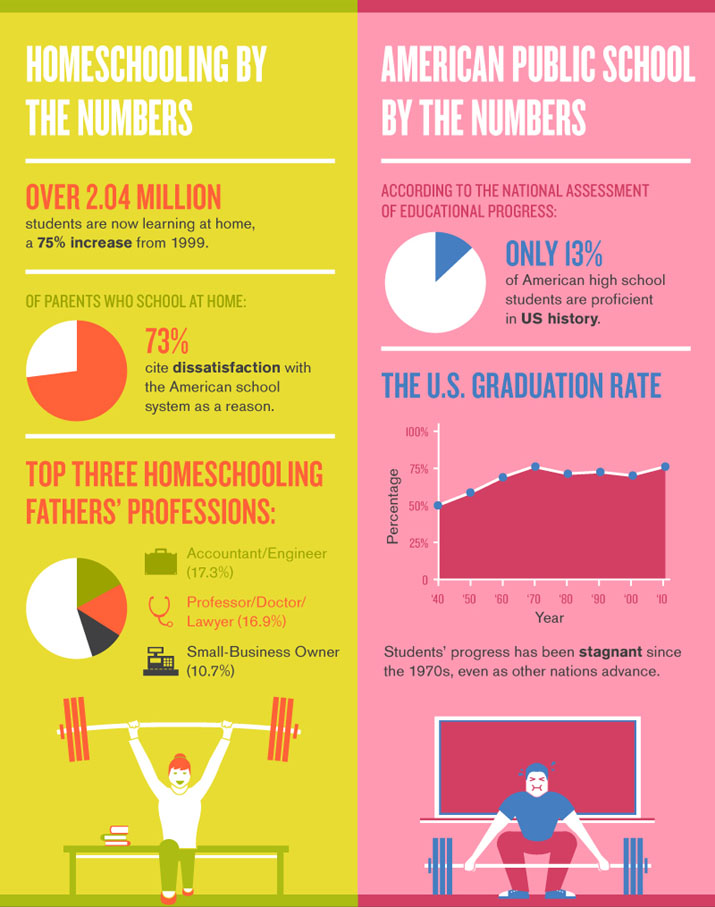
Homeschool Domination: Why These Kids Will Take You Down [infographic]

Interesting facts about Homeschooling vs Public schooling, you wonder why more and more parents are turning to homeschooling, this shows you why.

But are Homeschoolers a Little Odd? Studies Say No

Homeschoolers are Less Affected by External Factors

Homeschooler National Average Percentile Scores

When They Get to College, Homeschool Students Keep on Succeeding
Created by CollegeAtHome.com

Friday, October 11, 2013

Speak Up, Speak Out! Stop This Problem! #worldwidechokinggameawareness

So today is my youngest child's birthday, she is a happy healthy 10 years old today! I am blessed to have happy healthy children, but not immune to the things out there that they could try or get involved in.
Instead of choosing to plaster my social media and blogs today with mushy birth stories, I choose to Speak up and Speak Out today! October 11th is also World Choking Game Awareness Day and for all the parents out there that have lost children to this terrible game, this is for you!
Sharing this again on this blog also, please feel free to share, copy or reblog it.


Today is a day, just like any other say yes? For some maybe for others no! If you have ever lost a child, no day is the same, you wake up with a piece of your heart ripped from you  that just can't be replaced.
No parent wants another parent to ever go thru the heartache of child loss, so today we urge you to wake up and educate yourself on something that 75% of kids already know about. Your kids!
The choking game has many names, it's all over YouTube, the internet, social media and your kids schools.
A high school trend...no, kids as young as 9 are dying everyday. So join us today on Worldwide Choking Game Awareness Day 2013 and Speak Up, Speak out, speak to Your kids today!

We don't want to add another statistic to our list......

Happy birthday Sarah, she asks you to tell your kids about the dangers of the choking game!

Thursday, July 25, 2013

Learn At Home with Legos Series day 1 #homeschool #education


“Genius is one percent inspiration and ninety-nine percent
perspiration.” Thomas Edison


I have started using some of our favorite little toys to create learning tools for my homeschoolers. I thought I might share a few days worth of posts on all the wonderful things out there in the blogosphere you can find to homeschool with Legos. Boy there are a ton of resources out there, free resources, all you need is the Legos (some libraries actually loan them), a printer and your usual craft/art supplies to create lapbooks or notebooks if you please.

Our first stop was to learn about the toy itself, where did it come from, how was it made, when was it made etc. We already had the huge book on Legos (you can find on Amazon). I found several more additions to our homeschool library on Amazon.com. Here are a only a few I really like or ordered for myself.


This Infographic has some great information about the Timeline of Lego and the company!

The many Worlds of LEGO #lego

Stay tuned for some great lapbooking and notebooking resources on day 2 of my Learn at Home with Legos Series. For now we are going to play and learn!

Karma Media Team

Please share on your favorites social sites

LinkWithin

Related Posts Plugin for WordPress, Blogger...